RILayer

Youth Transition · next validation pathway

PAVRA Youth Transition

PAVRA is the proposed real-world implementation and validation pathway following the controlled Youth Transition demonstrator (YT-WM-001). It connects people, evidence, support and opportunity while keeping consequential decisions human-governed.

Current status

Partner development and validation design

West Midlands is the immediate flagship validation focus. No pilot has yet been commissioned or agreed.

Status as at

Human decision authority
Evidence-informed
Bounded validation
Partner co-design

What PAVRA tests

Can readiness-to-placement decisions become better governed in a real Youth Transition environment?

The validation question is whether young-person evidence, opportunity-provider readiness, support conditions, uncertainty and accountable human review can be brought together more clearly before consequential action. RILayer structures the governance conditions around that decision; it does not make the placement decision.

Validation boundary

PAVRA is the implementation and validation bridge between the controlled demonstrator and a bounded real-world pilot.

It is not a second demonstrator or another youth jobs platform. Additional tooling should only be built where an agreed bounded pilot, validated assumption, evidence requirement or partner/governance requirement makes it necessary.

PAVRA as the Catalyst

Connecting the Youth Transition system around better human decisions.

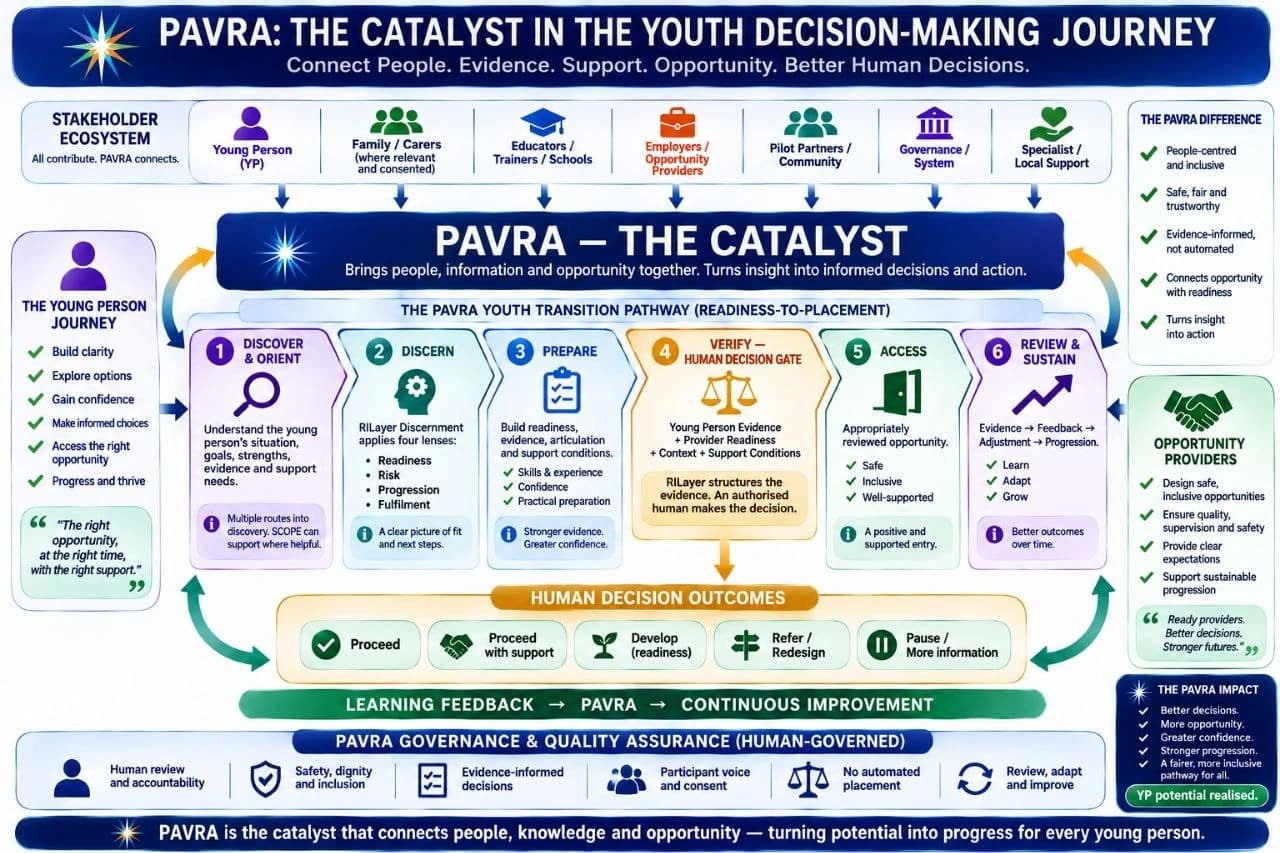
PAVRA brings together the young person, relevant support, available evidence, opportunity providers — for example employers, placement hosts, training providers or other organisations offering a progression opportunity — and accountable human review. The pathway is developmental rather than pass/fail.

PAVRA catalyst diagram showing young people and relevant stakeholders contributing to Discover and Orient, Discern, Prepare, human-governed Verification, Access, and Review and Sustain, with multiple human decision outcomes and continuous learning feedback.
PAVRA Catalyst stakeholder visual. The stage-by-stage cards below provide an accessible text equivalent.Open full-size diagram

Stage 01

Discover & Orient

Understand the young person's situation, goals, strengths, available evidence and support needs. SCOPE, an optional pre-governance reflection and orientation tool, may support discovery where useful; it is not a mandatory entry route.

Stage 02

Discern

Use the four Discernment lenses — Readiness, Risk, Progression and Fulfilment — to clarify fit, uncertainty and the next governed step.

Stage 03

Prepare

Build the evidence, articulation, practical preparation and support conditions required for a better-informed decision.

Stage 04

Verify · Human Decision Gate

Bring young-person evidence, opportunity-provider readiness, context and support conditions into an authorised human review. RILayer structures evidence; an accountable human makes the decision.

Stage 05

Access

Move into an appropriately reviewed opportunity when the governed decision supports access, with any agreed support or adjustments made explicit.

Stage 06

Review & Sustain

Use evidence, feedback and review to learn, adapt and support sustainable progression rather than treating placement as the end of the pathway.

Human decision outcomes

Verification does not force a single pass/fail result. An authorised human can choose the route justified by the evidence and operating boundary.

  • Proceed
  • Proceed with support or adjustments
  • Develop readiness
  • Refer or redesign
  • Pause or seek more information

What RILayer governs

Four practical questions make the control layer easier to understand.

RILayer organises the underlying controls around evidence, boundaries, operating conditions and accountable human authority while retaining the full governance concepts beneath them. Placement authority remains with an accountable human.

Do we know enough?

Evidence & readiness

  • Decision Readiness
  • Evidence sufficiency and provenance
  • Young-person readiness

What must be bounded?

Risk & boundaries

  • Governance Risk
  • Authority and supervision boundaries
  • Human review and escalation

Are the conditions workable?

Support & opportunity conditions

  • Support conditions
  • Opportunity-provider readiness

Who decides, and what is retained?

Human authority & record

  • Decision Evidence Record
  • Review rhythm and learning feedback

First flagship validation focus

West Midlands Youth Transition

The geography is a partner-development focus, not a claim of an agreed regional deployment.

The West Midlands is PAVRA's immediate priority geography for partner engagement and real-world validation discussions. SamSoyombo Career Pathways Ltd (SCP Ltd) is seeking appropriate regional partners to explore whether a bounded PAVRA Youth Transition pilot should be developed and, if so, what its scope, participants, governance requirements and success measures should be.

The proposed validation would test whether human-governed readiness-to-placement infrastructure can bring young-person readiness, opportunity-provider readiness, support, evidence, access and sustainable progression into a clearer accountable decision pathway.

Why the West Midlands is a relevant context

The West Midlands Combined Authority's 2026 WISE annex reported 29,850 youth claimants aged 18–24 in March 2026, equivalent to 9.7% of that age group, compared with 6.0% in England. The region is also operating a Youth Guarantee Trailblazer focused on young people aged 18–21.

These regional conditions justify asking the validation question; they are not evidence that PAVRA is effective. Any PAVRA work would need to complement, not duplicate, existing provision.

No West Midlands pilot has yet been commissioned or agreed.

Any pilot would remain subject to partner agreement, appropriate governance, safeguarding, data protection, operational readiness and an agreed pilot specification.

Participant boundary

YT-WM-001 is an 18+ synthetic demonstrator. The participant age range for any real PAVRA validation has not yet been fixed and would be agreed with the partner. Any scope involving under-18s would require the corresponding safeguarding, consent and governance arrangements.

Partner validation

What a West Midlands validation conversation would determine.

The first conversation is about fit, evidence and boundaries rather than selecting a pre-packaged pilot. A prospective partner and RILayer would determine the operating shape together before any build-out or deployment claim.

  • Decision environment and accountable decision owner
  • Participant boundary, including the age range
  • Opportunity-provider types and responsibilities
  • Minimum evidence and lawful data requirements
  • Safeguarding, consent, supervision and escalation
  • Validation period and operating rhythm
  • Success measures, learning questions and stop criteria
  • Tooling genuinely required for the bounded scope

Validation partnership

Govern the judgement moment before action.

Begin with one defined decision environment, examine the governance mechanism against real stakeholder needs and evidence, then decide what further validation is justified.

Human accountabilityEvidence traceabilityBounded validationDesigned for transferability